
Contract Analysis
ISO:9001 and GMP
Certified Laboratory
Paralab GMP Lab unlocks quality through compliance. With a team of experienced scientists and cutting-edge technology, we relentlessly focus on innovation and precision. Our GMP-certified laboratory offers a comprehensive suite of services tailored to the pharmaceutical industry. We customize our services to meet your specific needs, whether it is supporting API development, conducting detailed characterization, method development, performing reverse engineering, or conducting root cause analysis. With our expertise and capabilities, we aim to be your trusted partner in achieving success in the competitive pharmaceutical landscape.
Serviço de Análises
Laboratório Certificado
ISO:9001 e GMP
Dispomos de um serviço de análises em várias técnicas instrumentais, destinado às várias áreas: desde a área dos materiais até à área das biociências. Investimos nas infraestruturas e na qualidade dos nossos recursos humanos de forma a assegurar o melhor serviço.
Destacamo-nos pela experiência dos nossos especialistas nas diversas técnicas e respetivas áreas de aplicação. A nossa missão é satisfazer as suas necessidades tanto na realização de análises, desenvolvimento e validação de métodos; como na investigação de falhas ou causa raiz nas investigações de engenharia reversa.
SUPPORT & RESEARCH
Let's explore your sample together!

We distinguish ourselves by support we provide to our clients and by our research into differentiating parameters of product and/or process quality. A report is issued for each analysis request in Spanish, English or Portuguese.

PHARMACEUTICAL (GMP)

FOOD INDUSTRY

POLYMERS

OTHERS
Contact us
Our lab specialists are here to help you.
ANALYSIS/TECHNIQUES
Types of analyses
Scanning Electron Microscopy (SEM) is a technique applied to the characterization of materials. This technique allows the observation and characterization of the morphology of a sample, showing surface details up to the nanometric scale.
With this technique, we can observe the detailed morphology of the surface, as well as perform a dimensional analysis of the sample, measure its roughness, particle size, and determine the preferred location of elements (elemental mapping), among others.
Our benchtop SEM-EDS is equipped with:
Backscatter Electron Detector (BSED), which provides higher image contrast (sample areas where elements with higher atomic number are present appear lighter in the image) and enables the analysis of non-conductive samples without coating;
Secondary electron detector (SED) that provides more detailed surface and topographic information by detecting electrons diffused inelastically by the material;
Detector EDS (Energy Dispersive Spectroscopy) provides information on elemental composition of a sample.
Maximum magnification: 150000x
Resolution up to 17 nm (sample dependent)
Application Examples
Laser Diffraction is an experimental analysis technique that allows determining sizes and size distribution of particles in a range of a few nanometres to a few millimetres. A quantitative size distribution of the entire population of particles is obtained to determine which diameters represent a certain percentage of that population. The distribution can be in number or, more usually, in volume.
The theoretical models that allow the calculation of particle diameters are Fraunhofer’s and Mie’s. According to ISO 13320-1, Fraunhofer theory gives good results for particle sizes above 50 microns. For smaller sizes, in general, Mie’s theory is more appropriate. Mie’s theory is more complete and correct because it considers a certain degree of transparency of the particle to the laser, however this implies prior knowledge of the optical properties of the sample, namely its Refractive Index (RI) and Absorption Index (AI). Laser diffraction has proven useful for the following industries: environmental, ceramics, pharmaceutical, food and cosmetics.
The determination of particle size and distribution by the laser diffraction technique is recognized by numerous standards and standardization agencies including: ISO, ASTM, and USP.
Application Examples
Dynamic Light Scattering (DLS) is a technique that is commonly used to measure particle size and can estimate the distribution of submicrometere particles in scattering. DLS analyzes the hydrodynamic mobility of the particles. The success of the technique is mainly based on the fact that it provides estimates of the average particle size and size distribution within a few minutes.
Electrophoretic light scattering (ELS) is an indirect analysis of measuring electrophoretic mobility through the Doppler shift observed in light scattered by particles. In an ELS experiment, a beam of coherent light is focused on particles dispersed in a liquid and subjected to an electric field. The charged particles move toward either the anode or the cathode, depending on their charge on the medium. ELS provides fast, accurate, automatic, and highly reproducible electropherograms of complex particles dispersed in aqueous or non-aqueous media, without the need to use standard particles for calibration.
The mathematical models for correlogram analysis are the cumulant method for size and polydispersity; and the non-negative least squares method for size distribution. The Zeta potential is derived from the electrophoretic mobility using the Henry function, which can be approximated by the Smoluchowski equation or Hückel equation according to the relative thickness of the electrical double layer.
Application Examples
X-Ray Diffraction is a very versatile technique with broad application in the characterization of materials, since it allows the identification and quantification of different structural phases, determine crystallinity, and crystalline network parameters, gauge residual mechanical stress, among many other properties of powdered or whole materials, solids or liquids.
In the analysis of solid samples in refraction mode, the sample is irradiated by an X-ray beam which is subsequently refracted at certain angles according to the crystalline structure, according to Bragg’s Law of Refraction: nλ = 2d sinθ where n is the order of refraction (n = 1, 2, …), λ is the wavelength of the incident beam, d is the spacing between atomic planes in the crystal, and θ is the angle formed between the incident beam and the plane of refraction.
Since each substance has a unique spectrum, the relative number, and intensity of the peaks in a sample allow the identification of different phases present and therefore the determination of their qualitative composition. The quantitative composition can be determined using a calibration curve. Alternatively, it can be calculated using the RIR (Reference Intensity Ratio) method, where a pre-established proportionality factor is used between the most intense reflections of each phase and a standard substance (Al2O3-corundum).
Application Examples
Rheology is the study of the flow and deformation of materials when a force is applied, usually using a rheometer. Rheological properties are referred to all fluid materials, from dilute solutions of polymers and surfactants through concentrated protein formulations; semi-solid materials such as pastes and butter to, molten materials, and solid materials such as polymers and asphalt.
Many materials and formulations exhibit complex rheological properties, whose viscosity and viscoelasticity differ depending on the external conditions applied, such as stress, pressure, time, and temperature. Internal sample differences, such as chemical nature, concentration and stability, and the type of formulation are also key factors for rheological properties.
The type of rheometer required for measuring these properties often depends on the appropriate shear rates and time frames, as well as the sample size and viscosity.
Application Examples
Gas chromatography (GC) is an essential analytical technique in chemistry, providing valuable insights into substance composition and purity. It plays a central role across various industries, including pharmaceuticals. GC separates and quantifies volatile compounds in complex mixtures, offering precise results. In pharmaceuticals, GC ensures product quality and safety by identifying the purity of APIs, impurities present, degradation products, and residuals solvents. GC analysis is crucial for quality control and is recognized by numerous standards and standardization agencies, including ISO, ASTM, and USP.
Application Examples
The dissolution test is a fundamental tool in pharmaceutical analysis, offering valuable insights into the performance and consistency of drug products. It plays a vital role in ensuring the efficacy, safety, and quality of pharmaceutical formulations. This test provides critical information about the drug's release characteristics, which are essential for assessing its bioavailability and ensuring consistency in manufacturing. The dissolution test is described in the USP Chapter <711>.
Differential Scanning Calorimetry (DSC) is one of the most widely used techniques in the thermal characterization of materials. In this technique, the heat flow between the sample and a reference is monitored when subjected to a controlled temperature program, which changes whenever there is a phenomenon in the sample that consumes or releases energy. These phenomena may be of a physical or chemical nature. Physical transformations include melting, crystallization, vaporization, and glass transitions, among others. On the other hand, chemical transformations involve reactions that include decomposition, combustion, chemical absorption, polymerization, solid-solid transitions, among others.
The DSC technique allows not only to determine the temperature at which a given endo/exothermal phenomenon occurs, but also to determine the amount of energy (enthalpy) involved in it. In addition to this type of information, the technique also allows one to measure heat capacity values of a material in accordance with ASTM E 1269, ISO 11357-4 and DIN 51007 standards, as well as determine degrees of purity or perform kinetic studies.
Application Examples
Thermogravimetry is a Thermal Analysis technique where the loss or gain in mass of a sample when subjected to a controlled temperature program is monitored. The changes in mass can be due to chemical processes, such as decomposition reactions with gas release or combustion reactions, and physical processes, such as vaporization of volatiles or absorption of moisture, among others.
The combination of this technique with others such as DSC or analysis of the gases released (FTIR, MS, GC-MS) allows a more concrete identification of the phenomena and allows inferences about the reaction mechanism. This fact, together with the mass loss associated with the phenomenon, enables the quantification of the different components that constitute the sample.
Application Examples
XRF
X-Ray Fluorescence (XRF) is a non-destructive analytical technique used to determine the elemental chemical composition of all types of materials except gases. For this reason it is the method of choice for many different types of applications, particularly in quality control of materials and industrial production. The XRF technique is excellent for both qualitative and quantitative analyses.
The technique is subdivided into two categories: Energy Dispersive XRF and Wavelength Dispersive XRF (ED-XRF and WD-XRF, respectively). The difference between the two lies in the signal processing and detection. In the ED-XRF technique, the X-ray photons emitted by the sample are detected simultaneously, usually by a solid-state semiconductor detector, while in WD-XRF the X-rays are diffracted by a crystal to be separated into their wavelengths and then detected. The ED-XRF technique is usually faster and the equipment is simpler and easier to use. WD-XRF equipment is usually larger, more complex and slower to measure, but can detect more elements (up to Beryllium), with better resolution and lower detection limits.
Application Examples
Quantification of Silicon in textile fibers
Verification of possible contaminations in flours resulting from milling
Elemental quantification of liquid paints
Elementary quantification of phosphoric rocks
Detection of defective auto parts
Quantification of chlorides remaining from the synthesis of new APIs
Liquid Density
The density of liquids is a specific property that can be used in the quality control of some products, such as milk and fuels.
Refractive Index
Determination of refractive index is important as it is a characteristic property of each substance and can therefore be used to identify them.
Elemental Analysis (DUMAS and CHNS)
Enables the determinination of quantitative composition of a material, identifying the elements present and their relative proportions. These analyses are commonly applied to samples of chemical substances, organic and inorganic compounds, metal alloys, minerals, among others.
Customers
Some customers who trust us




ANALYSIS SERVICE TEAM
Multidisciplinary team
Our commitment is based on the team's long experience and multidisciplinary approach.
Bruno Machado, PhD
Materials & Chemistry
Hugo Gonçalves, PhD
Physics
José Catita, PharmaD, PhD
Pharmacy
Paulo Silva, PharmaD, PhD
Technical Director GMP
Regina Torre,
PhD student
Chemistry
Fábio Major,
MSc
Biological Chemistry


Knowledge
Application Notes






Porto
(Headquarter)
Rua Dr. Joaquim Manuel Costa, 946 B
4420-437 Valbom, Gondomar
Phone: +351 224 664 320*

FOOD INDUSTRY
Granulometry by Laser Diffraction
Coffee is one of the most popular and widely consumed beverages in the world today due not only to its stimulating effects on the central nervous system, but also because of its taste and aroma.
One of the crucial steps in processing coffee beans is the grinding, since different types of final use (e.g., espresso, filter coffee, mocha, capsules) require different grinding degrees to adjust specific parameters such as bitterness, acidity, sweetness, or aroma. All these parameters are highly influenced by particle size.
It is important not only to adjust the particle size of coffee powder, but also to control the overall uniformity of the grinding process.
In the past, sieve analysis was the main method to carry out size measurements, however this technique is time consuming and quite limited. Laser Diffraction is an alternative technique that allows automation and delivers results with higher quality, quicker and in real-time, optimizing the desired product properties.
The right side graphic shows the particle size distributions of four coffee samples in capsule and one sample of soluble coffee. Through its analysis we can observe that soluble coffee has a higher D90 and D50 than coffee in capsules, which is expected considering the differences in the grinding process. Also capsule coffee present different size distributions depending on its type (expresso, decaffeinated, ristretto or lungo)
The equipment used in this work was Mastersizer 3000’s with Aero S dry powder disperser from Malvern, a laser diffraction analyzer that delivers measurements from 10 nm to 3.5 mm using a single optical measurement path, making it suitable for an extremely wide range of application.
For more information, please click on the Brochure.
Analysis reports can be prepared in English (default), Portuguese or Spanish.
Other services can be requested on demand. They include analytical methods development and validation, route cause analysis support, reverse engineering support and technical consultancy in material characterization.

FOOD INDUSTY
Elementar analysis by Combustion
Protein is a nutrient human being needs to grow and repair cells and to work properly. Protein is found in a wide range of food and it is important to get enough protein in daily diet.
The increase in consumer demand for protein-rich foods has led to increased control of their content in various products, particularly milk and its by-products.
Whey Powder is one of the best-known supplements used by athletes as it contains the essential amino acids for muscle recovery and construction.
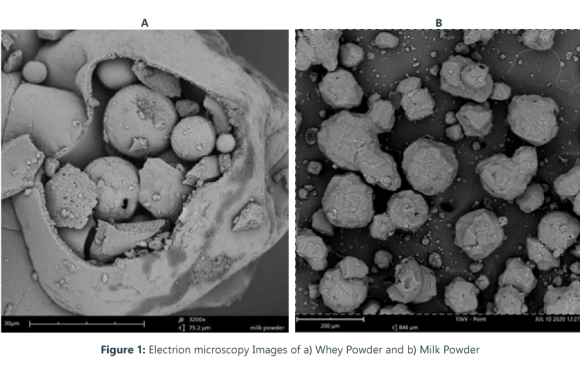
Milk Powder is marketed because it offers preservation advantages, since it does not need to be refrigerated due to its low moisture content. Another advantage is to reduce its transport volume.
In this study, elemental analyses by combustion were performed on milk and whey powder samples to quantify its nitrogen amount and estimate the protein content in the samples.
Table 1: Carbon and nitrogen results obtain for whey powder and milk powder and their respective Protein values.
| SAMPLE | C (%) | N (%) | Protein (%) |
|---|---|---|---|
| Whey Powder | 40.95 ± 0.11 | 1.98 ± 0.02 | 12.6 ± 0.1 |
| Milk Powder | 45.51 ± 0.12 | 5.39 ± 0.06 | 34.3 ± 0.3 |
The instrument used was the vario MACRO cube CHNS, from Elementar®, using combustion of the sample to promote an instantaneous oxidization into simpler compounds which are then detected by thermal conductivity. For more information, please click on the brochure.
Analysis reports can be prepared in English (default), Portuguese or Spanish.
Other services can be requested on demand. They include analytical methods development and validation, route cause analysis support, reverse engineering support and technical consultancy in material characterization.

CONTRACT ANALYSIS | POLYMERS
X-Ray Diffraction (XRD)
Insulation of electrical conductors is a critical safety feature to prevent short circuits, fire hazards or electric shocks. An insulator is a material or medium that has a high resistivity towards conducting electric current. There are numerous materials employed to achieve such insulation like polymers (typically Polyvinyl Chloride (PVC), Polyethylene (PE) and rubbers), ceramics, sand, air or vacuum.
Insulation of electrical wires and home cables can be achieved by covering them with suitable polymer layers. Its properties – mechanical behaviour, chemical stability, fire resistance and others, are usually modified or improved by additives.
In this study, identification of additives on the surface of a polymer insulator of electrical wires was performed using X-Ray Diffraction (XRD) with parallel beam geometry. The obtained diffractogram, shown below, allowed the identification of two different additives: calcite-for improved stiffness and impact resistance, and a Mg-Al layered double hydroxide- for flame retardation.
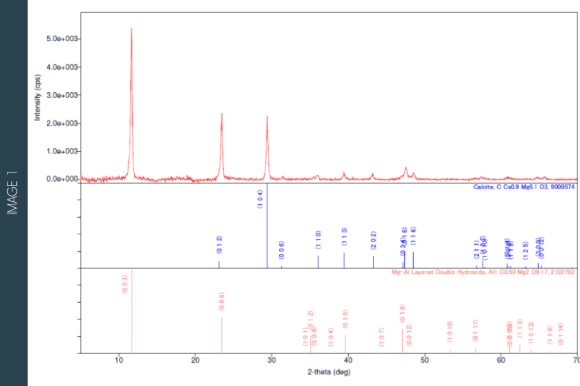
The equipment used in this work was Smartlab from Rigaku equipped with a 9kW rotating anode X-Ray generator. Smartlab is an automated multipurpose X-ray diffractometer with a theta/theta configuration. For more information, please click on the brochure.
Analysis reports can be prepared in English (default), Portuguese or Spanish.
Other services can be requested on demand. They include analytical methods development and validation, route cause analysis support, reverse engineering support and technical consultancy in material characterization.

Pharmaceutical
Differential Scanning Calorimetry (DSC)
The freeze-drying process is important in the pharmaceutical and biotechnology industries to stabilise, store, or increase the shelf life of formulations and other biologicals. Freeze-drying uses a process called lyophilization to lower the temperature of the product below freezing, and then vacuum is applied to extract the water in the form of vapour (sublimation). Knowing the phase diagram of the formulation is paramount to define and optimise the freeze-drying process.
Formulations may form a eutectic system which is characterized by the eutectic melting line, the lowest achievable melting temperature across the entire composition range and, at a specific homogeneous mixing ratio, they present a single melting point. Eutectic system characterization is important since the freeze-drying process conditions must be set based on the eutectic temperature.
In this study, a thermal characterization of a freeze-dried formulation was performed using Differential Scanning Calorimetry (DSC). The picture shows a DSC thermogram where two endothermic effects are visible. The first one (yellow arrow) corresponds to the transition S/S+L of the eutectic mixture, while the second one (red arrow) corresponds to the transition S+L/L, as exemplified by the phase diagram on the left.
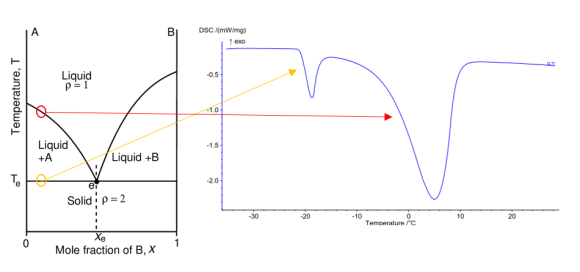
The equipment used in this work was DSC 214 Polyma from Netzsch equipped with an intracooler (temperature range from -40ºC to 600ºC). For more information, please click on the Brochure.
Analysis reports can be prepared in English (default), Portuguese or Spanish.
Other services can be requested on demand. They include analytical methods development and validation, route cause analysis support, reverse engineering support and technical consultancy in material characterization.
FOOD INDUSTRY
X-Ray Fluorescence
Cereals, consumed as whole, treated grains or in milled form (flower), constitute the base of all human and farm animals feed. Worldwide, cereal production in 2017/2018 surpassed 2 700 million tons (data obtained from FAO website), with wheat and rice representing 47%.
Industrial milling is achieved by means of stainless-steel blades which, if not properly maintained, can contaminate the flower with iron, chromium and nickel.
In this study, two milled products of the same cereal were analysed to verify the possible contamination with metals during the milling process.
X-Ray Fluorescence (XRF) is a non-destructive elemental analysis technique which provides both qualitative and quantitative data ranging from sub-ppm to 100% (m/m), depending on the equipment, matrix and element considered.
The Image 1 is a zoomed view of the overlaid spectra of both samples analysed. This region evidences the presence of Chromium and Nickel in the sample identified as “Suspect” while absent in the sample identified as “Good”. Additionally, the iron amount is significantly higher in the “Suspect” sample. Both results indicate that the “Suspect” sample has indeed been contaminated by the stainless-steel blades during milling due to its wear.

The equipment used in this work was Supermini200 from Rigaku, a tabletop WD-XRF. The range of analysed elements goes from Oxygen to Uranium and can measure both solids and liquids in helium or vacuum atmosphere. For more information, please click on the Brochure.
Analysis reports can be prepared in English (default), Portuguese or Spanish.
Other services can be requested on demand. They include analytical methods development and validation, route cause analysis support, reverse engineering support and technical consultancy in material characterization.
PAINTS AND COATINGS
Zeta potential
Pigments are designed and produced to be insoluble particles used to impart colour in a variety of materials. The diverse range of its chemistries, the end use requirements, and the broad range of colours available create a challenge for chemists when incorporating them, being stability and settling one of the many factors to consider. The first steps in the pigment dispersion process are wetting and separation of the pigment. However, if the pigment dispersion is not properly stabilized, flocculation will result.
One of the main mechanisms to obtain pigment stabilization is charge repulsion, in which particle surfaces with like charges repel each other. Properly stabilized pigment dispersions prevent flocculation and agglomeration.
Zeta potential serves as a reference as to how stable the formula will be. Pigment dispersions with a zeta potential between +30 mV and -30 mV have a high probability of being unstable.
In this study, zeta potential was measured by Electrophoretic Light Scattering. Sample was a water dispersion of a pigment used in the automotive industry. Results obtained (image 1) are compatible with a stable dispersion as average zeta potential is -42,3 mV.

The equipment used in this work was Zetasizer from MalvernPanalytical and sample cell was a folded capillary cell. For more information, please click here.
Analysis reports can be prepared in English (default), Portuguese or Spanish.
Other services can be requested on demand. They include analytical methods development and validation, route cause analysis support, reverse engineering support and technical consultancy in material characterization.

METAL
Metal | Optical Emission Spectroscopy (CHISPA)
Metallic Alloys have always been one of the cornerstones of mankind evolution for millennia. Naturally occurring or man-made, they have been used in construction, coinage, automotive industry, jewellery, technology development, and many others. Alloys are a combination of at least one metal element with other metallic or non-metallic elements.
The chemical composition of the alloys, namely the base and alloying elements and their relative proportions (as well as the heat treatment), are decisive to define their mechanic and reactivity behaviour. Different alloys are then selected according to the desired characteristics for the intended usage. Due to the huge variety of existing alloys and due to its relevance, the chemical composition ranges of the existing alloys are established by a series of international standards. It is, therefore, of extreme importance to be able to measure the chemical composition of an alloy.
In this study, a metallic cylinder block was analysed to confirm if it was made of Stainless Steel AISI 316L. The analysis was performed using Optical Emission Spectroscopy (OES) technique, where the metal surface is hit and burned with a high voltage spark in argon medium. This produces a characteristic round black burn spot as shown in the figure (image 1). The measured chemical composition was indeed compatible with Stainless Steel AISI 316L.

The equipment used in this work was Foundry Master Pro 2 from Hitachi. For more information, please click in the brochure.
Analysis reports can be prepared in English (default), Portuguese or Spanish.
Other services can be requested on demand. They include analytical methods development and validation, route cause analysis support, reverse engineering support and technical consultancy in material characterization.

POLYMERS
Thermogravimetry (TGA)
Polymers blends are physical or mechanical mixtures of two or more polymers, analogous to the metal alloys. The purpose of the blend is to enhance or impart additional characteristics to the polymers that best suit the desired application.
The blended polymers can be miscible, immiscible, or partly miscible in certain conditions. Most polymer blends are immiscible or partly miscible and, in this case, the individual polymer characteristics remain. This means that the blends can be separated in their individual polymer constituents.
In this study, an immiscible two-polymer blend was analysed with the purpose of quantifying both polymers. Thermogravimetric Analysis (TGA) was used for this analysis. Since both polymers have close decomposition temperatures, the quasi-isothermal approach was used to separate both phenomena and allow proper quantification.
The obtained thermogram, shown in the image 1, showcases two mass loss steps. Based on the weight left on the crucible as the result of the pyrolysis (residual mass), mass losses were normalized to 100%, with one polymer being calculated as 87% and the other one as 13%.

The equipment used in this work was an STA 449 Jupiter from Netzsch®. For more information, please click on the brochure.
Analysis reports can be prepared in English (default), Portuguese or Spanish.
Other services can be requested on demand. They include analytical methods development and validation, route cause analysis support, reverse engineering support and technical consultancy in material characterization.
POLYMERS
Scanning Electron Microscopy (SEM)
Microcapsules are hollow microparticles composed of a solid shell surrounding and entrapping substances in their core. They are containers that are able to release their contents when appropriate or needed and in a controlled way. There are numerous substances that can be encapsulated, such as pesticides, perfumes, API’s, dyes and pigments, flavours or food additives. It all depends on the intended application.
Microcapsules find in Textiles one of its major areas of industrial application. They started being used in textile products during the 1970’s and the range of applications increased dramatically with the technological advances. One of the applications is the dispersion of microcapsules of fragrances in woven textile fibres. Such fragrances are released when the microcapsules burst due to mechanical friction, such as rubbing.
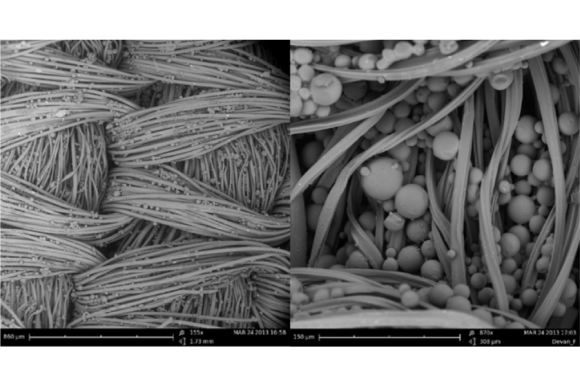
In this study, a textile impregnated with perfume microcapsules was analysed by Scanning Electron Microscopy (SEM) to verify the efficiency of the dispersion. The pictures below show that the microcapsules are well dispersed in between the woven fibres, with sizes ranging from approx. 5 to 50 µm.
The equipment used in this work was SEM Phenom ProX from Thermo Fisher Scientific. For more information, please click here.
Analysis reports can be prepared in English (default), Portuguese or Spanish.
Other services can be requested on demand. They include analytical methods development and validation, route cause analysis support, reverse engineering support and technical consultancy in material characterization.